Improving R.O. Pre-Treatment at a Pharmaceutical Manufacturing Plant

The Problem
A global Pharmaceutical CDMO (contract development and manufacturing organization) draws process water for its plant from an on-site well, feeding the same set of filter housings year-round. The site had been running an electro- adsorptive nano-alumina depth cartridge on this duty. That media captures fine particles by charge attraction rather than by pore size alone, so it holds very fine organic and microbial matter well. On high-solids well water, however, that construction loaded up quickly.

The Solution
Strainrite specified DS1-40C3S, a single-media pleated Clarity™ cartridge configured around the system’s actual flow rate and solids loading rather than a catalog default. It drops straight into the existing housings, so nothing about the skid, the piping or the changeout procedure.

Situation
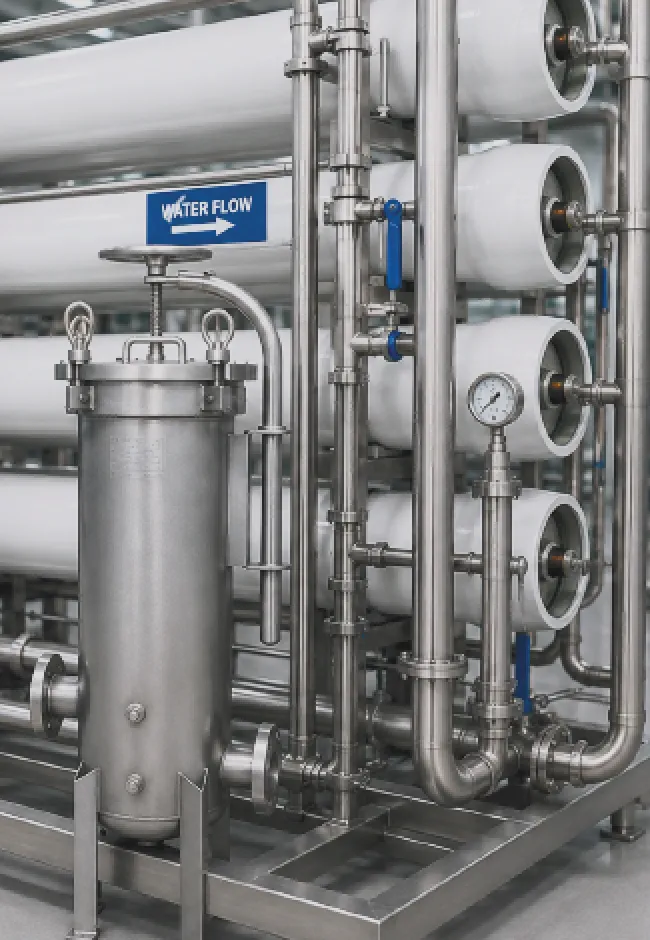
The plant draws its process water from an on-site well and conditions it before it reaches a reverse osmosis system. Water passes through a bag filter that takes out gross particles, then through mixed media filters, and then through a cartridge stage whose specific job is to reduce the colloidal material that fouls RO membranes. Colloids are what the RO system cannot defend itself against. Left in the feed water they blind the membranes, push differential pressure up and shorten the interval between membrane changeouts. This stage is the last barrier in front of the most expensive assets on the skid. That stage was not holding up. Variable, high-solids well water loaded the incumbent cartridges quickly, so the plant was changing elements far more often than it wanted to — paying once for the cartridge and again for the labor to take a housing offline, swap elements and document the work.
Incumbent Filters Being Replaced:
-
 Electro-adsorptive nano-alumina depth cartridge
-
1.25 micron mean pore size
-
Maximum differential pressure 30 psid (2.1 bar)
-
Maximum operating temperature 176 degrees
Solution
Strainrite specified DS1-40C3S, a single-media pleated Clarity™ cartridge configured around the system’s actual flow rate and solids loading rather than a catalog default. It drops straight into the existing housings, so nothing about the skid, the piping or the changeout procedure.

What We Changed:
Sized to the duty, not the catalog:
The media and pleat configuration were selected for the colloid loading in this feed water, which is what determines how long an element lasts in service.
Pleat configuration built for capacity:
Strainrite engineered the pleat geometry to put more effective media area inside the same envelope, so the element holds more before differential pressure forces a changeout at the same flow.
Length chosen for the flow rate:
40 in. elements matched this system’s flow. The cartridge is manufactured in multiple lengths, so the same method applies to housings of any depth.
Drop-in for the existing housings:
No housing, piping or skid modification, and no change to the way operators run a changeout.

Results
2-3x Cartridge Service Life:
The Strainrite elements are lasting two to three times longer than the incumbent cartridges they replaced, as reported by the end user.
Reduced Labor and Downtime:
Fewer changeouts mean fewer housing entries, less spent element disposal and less documentation, reducing both filter costs and labor costs.
Lower Cartridge Cost:
The Strainrite element also carries a lower unit cost than the incumbent, so the saving comes from price and from frequency rather than one or the other.
Steadier Protection for the R.O.:
Holding colloid reduction consistent for longer is the point of this stage. The plant is tracking RO performance to quantify the effect on membrane life.
Request a Custom Filtration Quote
Get fast, expert guidance and custom quotes tailored to your filtration process.